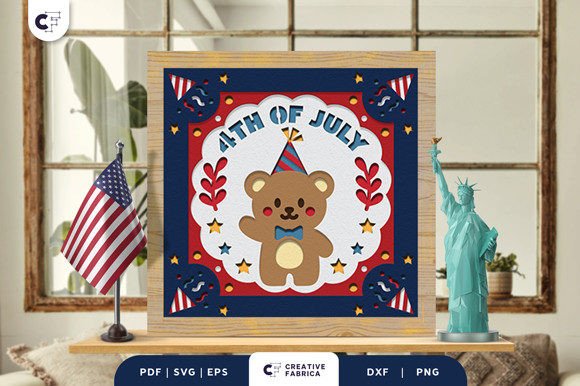
Reviewing the 4th of July Bear Shadow Box SVG
As a designer who spends more time staring at stitch simulations than actual fabric, I have learned to be skeptical of trendy digital assets. We see thousands of files pass through our libraries every season, but only a few earn a permanent spot in the "client-ready" folder. This week, I took a close look at the 4th of July Bear 3D Shadow Box SVG. While the product description highlights its suitability for party decorations and light box visuals, my focus was strictly on how this design translates into thread. Can a file built for paper layering truly work as a machine embroidery design? Here is my practical assessment for fellow makers, Etsy sellers, and boutique owners.
First Impressions: Mood and Visual Personality
The immediate appeal of this design lies in its whimsical yet patriotic tone. It captures the playful spirit of Independence Day without relying on the overly aggressive or cliché imagery we often see in July. The bear cub motif adds a layer of softness that makes the design versatile. It does not scream "political statement"; instead, it whispers "summer celebration." This subtle distinction is crucial for custom apparel and personalized gifts. Customers looking for holiday items often want something festive but wearable year-round or suitable for a child’s nursery. The layout suggests a balanced composition, which is essential when you are working within the constraints of an embroidery hoop. The visual personality is friendly, approachable, and distinctly American, making it a strong candidate for holiday embroidery projects that need to feel warm rather than formal.
Real-World Application: From Screen to Stitch
To test the viability of this asset, I imagined a specific real-life scenario: a custom order for a local boutique selling high-end tote bag design options. The client wanted a limited-edition July release. I visualized the 4th of July Bear 3D Shadow Box SVG stitched onto a heavy canvas tote. In this context, the design’s structure matters immensely. If the original file is intended for a 3D paper shadow box, it likely relies on distinct layers to create depth. In embroidery, we achieve this depth through thread density and color variation rather than physical layering.
For a sweatshirt embroidery project, this design could shine if adapted correctly. The bear shape provides a solid foundation for fill stitch work, while the surrounding elements might require precise satin stitch borders to keep edges clean. I also considered its use on a baby embroidery item, such as a onesie or a burp cloth. Here, the scale becomes critical. A design that looks robust on a poster might overwhelm a small garment. However, if the details are simplified, the cute factor of the bear cub makes it an excellent seller for new parents celebrating their first July 4th. For embroidered patch creators, this design offers a clear silhouette that would cut cleanly, provided the inner details are not too fine.
Navigating Technical Challenges
While the aesthetic is promising, there are technical hurdles to consider before loading this into your machine. The term "3D SVG" implies complexity. In the world of digitizing, complex visuals often translate to high stitch density. If you are stitching this on thin fabric or stretchy materials like jersey knits, you must be cautious. High density can cause puckering, ruining the finished product before it even leaves the hoop. I strongly advise using a cut-away stabilizer for any knit garments and a tear-away for woven fabrics like cotton twill or linen.
Another concern is the level of detail. Small corners and tiny elements, which look crisp in a vector preview, can become a nightmare under the needle. If the design includes intricate shadows or fine lines meant for paper cutting, these may need to be thickened or removed entirely for embroidery. Stitching on curved surfaces, such as caps, requires extra vigilance. The design must be centered perfectly, and the pull compensation needs to be accurate to prevent distortion. Always check whether the design works for both personal and commercial projects by reviewing the license terms explicitly. Do not assume that because it is an SVG, it is ready for immediate stitching without digitizing adjustments.
Enhancing Product Value and Brand Consistency
Why choose this specific design over a generic flag or eagle? Because it builds brand consistency for shops that focus on family-friendly, handmade aesthetics. When a customer sees a well-executed bear motif, they associate your craft business with quality and attention to detail. This impacts buyer engagement significantly. A unique design stands out in a saturated market. For small shop product lines, having a signature holiday item can drive repeat traffic. The 4th of July Bear 3D Shadow Box SVG allows for creativity in thread colors. You are not locked into traditional red, white, and blue. Imagine a pastel version for a spring-themed baby shower or a monochrome version for a modern, minimalist handmade product. This flexibility increases the design's lifespan beyond a single holiday.
Practical Designer Notes for Execution
Before you commit to a large production run, follow these steps to ensure success:
- Test on scrap fabric first: Never stitch directly on your final garment. Use a similar weight and texture to check for puckering or thread breaks.
- Check thread color contrast: Ensure your chosen threads provide enough contrast to make the design readable from a distance. Low contrast can make detailed areas look muddy.
- Review stitch density: If the file is not already digitized for embroidery, you will need to convert it. Pay close attention to underlay stitches to stabilize the design.
- Confirm hoop size: Measure the design dimensions against your machine’s maximum hoop capacity. You may need to resize, which can affect stitch quality.
- Inspect small details: Zoom in on the digital file. Are there elements smaller than 2mm? These may need to be removed or merged.
- Test in black and white mockups: This helps you see the value structure without the distraction of color, ensuring the shape holds up visually.
- Compare light and dark fabric backgrounds: A design that looks great on white might disappear on navy. Adjust your thread palette accordingly.
- Use proper stabilizer: Match the stabilizer to the fabric weight. Incorrect stabilization is the most common cause of poor embroidery results.
- Confirm licensing: Verify if the digital embroidery file or SVG allows for commercial use of finished items. Some licenses restrict sales volume or require attribution.
Final Verdict
The 4th of July Bear 3D Shadow Box SVG is a charming asset with strong potential for the right applications. It is not a plug-and-play solution for every machine without consideration, but for the thoughtful designer, it offers a fresh take on patriotic themes. Whether you are creating custom apparel, decorative pillows, or unique design assets for your online store, this design rewards careful preparation. By respecting the technical limits of embroidery and leveraging the cute, approachable nature of the bear motif, you can create a finished product that customers love. Remember, the best embroidery is not just about the design file; it is about how you adapt that design to the physical realities of thread and fabric. Treat this file as a starting point for creativity, not just a final output, and it will serve your commercial embroidery goals well.